
Drone Motor Testing: Thrust and Efficiency Bench

Introduction
A drone spends most of its battery on propulsion. On a typical multirotor, the motors and propellers draw around 80% of the total power in hover. So a small gain in propulsion efficiency, even 5%, can add real minutes to your flight time. The only way to know if a motor and propeller pair is efficient is to measure it.
This guide shows you how to test a drone motor on a bench for thrust and efficiency. You will see what to measure, how to build a thrust stand, how to drive the motor, and how to turn raw numbers into a curve you can trust. The goal is a repeatable test, not a guess from a spec sheet.
What a Drone Motor Test Bench Measures
A drone motor test bench spins a motor and propeller while it records what goes in and what comes out. On the input side it measures voltage and current, so it knows the electrical power in watts. On the output side it measures thrust in grams or newtons, plus torque and RPM.
From those channels the bench computes the number that matters most: propulsion efficiency, usually given as grams of thrust per watt (g/W). A higher g/W means more lift for the same battery drain. Two motor and propeller pairs can produce the same thrust while one of them wastes far more power, and only the bench tells them apart.

Takeaway: a drone bench links electrical power in to thrust out, so you can compare real efficiency, not datasheet promises.
Building the Thrust Stand
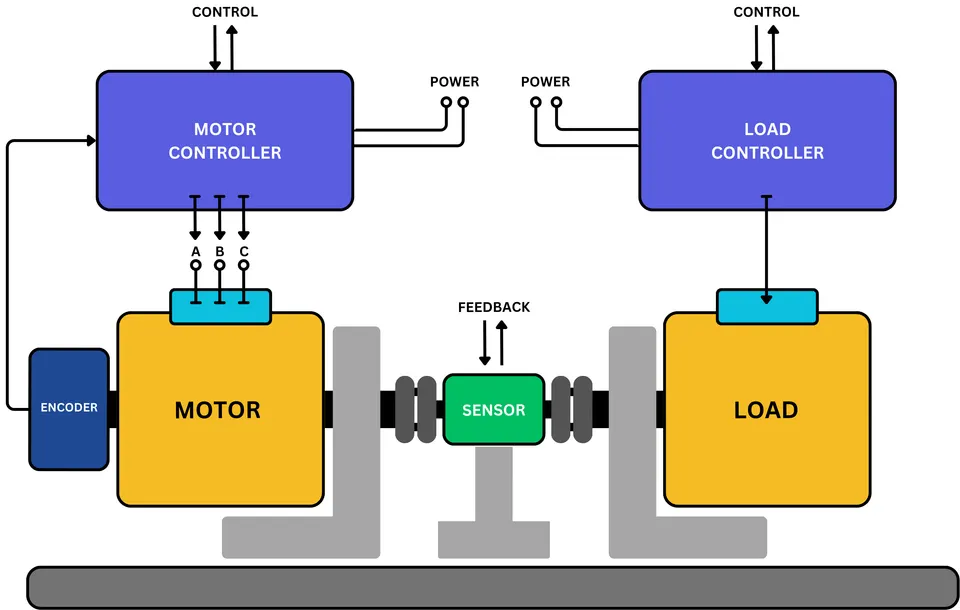
A drone thrust stand is simpler than a full dynamometer, because the propeller is the load. The air does the loading for you. What you need is a rigid frame, a way to measure the force the propeller makes, and clean electrical and speed sensing.
Thrust and Torque Sensing
Thrust is the lift force the propeller makes along the motor axis. You measure it with a load cell, a sensor that outputs a small voltage proportional to force. Mount the motor on an arm or a sliding plate that pushes against the load cell, so all the thrust goes through the sensor and nothing leaks into the frame.
Torque is the reaction force the propeller puts on the motor as it spins. A second load cell, set at a known distance from the shaft, captures it. Torque matters because it tells you the mechanical load on the motor, which feeds straight into your efficiency math. Pick a load cell range that covers your peak thrust with some room left, but not ten times more, or you lose resolution at low throttle.
Mounting Motor and Propeller
The motor mount must be stiff. Any flex in the arm bleeds force away from the load cell and adds noise to the reading. Use a metal bracket, bolt it down hard, and keep the motor axis square to the sensor.
Test the motor with the propeller you actually fly. A motor measured bare, or with a different prop, gives numbers you cannot use. The propeller diameter, pitch, and even the brand change thrust and current a lot, so the pair is the unit under test, not the motor alone.
RPM and Vibration
Measure RPM with an optical sensor, a hall sensor, or by reading the electrical frequency from the drive. RPM ties thrust and current to a real operating point, so you can plot how the pair behaves across the throttle range.
Watch vibration too. An unbalanced propeller or a loose mount shows up as a shaking thrust reading and can damage the stand. If the signal jumps around, stop and check balance before you trust the data.
Safety note: a propeller at full throttle is dangerous. Always put a guard or containment cage around the prop before any run. More on this below.
Takeaway: a good thrust stand is stiff, uses load cells sized to your thrust, and always tests the real motor and propeller together.
Driving the Motor: ESC vs Controller
A drone motor is almost always a BLDC or PMSM type, and it needs a three-phase drive to spin. You have two ways to drive it on the bench.
The common path is a standard ESC (electronic speed controller), the same part the drone flies with. It takes a throttle signal and spins the motor sensorless. This is fine for a basic thrust check. The limit is data: most flight ESCs give you little or no feedback, so you measure power and RPM with separate sensors and you cannot script precise test steps.
The better path for a real test is a motor controller that runs closed-loop FOC (field oriented control) and reports its own data. A drone motor runs sensorless at high RPM, often past 20,000 electrical RPM, so the controller needs solid high-speed sensorless estimation. A controller like this can hold a commanded speed, log voltage, current, and RPM on its own, and accept commands over a bus such as CANopen. That lets you automate a full throttle sweep and read every channel from one device instead of stitching together meters.
Takeaway: an ESC works for a quick thrust check, but a closed-loop FOC controller gives you repeatable, logged data for real validation.
Electrical Measurement and Efficiency
Power In vs Thrust Out
Electrical power in is simple: power equals voltage times current. Measure both at the motor input, after any wiring, so you capture what the motor really draws. Use sensors rated for your peak current, and average the reading over a steady window, because drone current is noisy from fast PWM switching.
Thrust out comes from the load cell. Once you have power in and thrust out at the same operating point, efficiency is just thrust divided by power, in grams per watt. Do this at several throttle settings, not one, because efficiency changes a lot across the range.
Building a Thrust-vs-Throttle Curve
Step the throttle from low to high and record thrust, current, and RPM at each step. Plot thrust against throttle, and plot g/W against thrust. These two curves tell you almost everything about a propulsion setup.
| Throttle | Thrust (g) | Power (W) | Efficiency (g/W) |
|---|---|---|---|
| 25% | 250 | 35 | 7.1 |
| 50% | 600 | 110 | 5.5 |
| 75% | 950 | 220 | 4.3 |
| 100% | 1250 | 360 | 3.5 |
The numbers above are an example shape, not a spec. Notice the pattern: efficiency is highest at low throttle and drops as you push for more thrust. That is normal, and it is why hover efficiency matters more than peak thrust for flight time. A detailed efficiency map across the full operating field is its own topic, so here we stay on the drone-specific thrust and efficiency curve.
Takeaway: a thrust-vs-throttle curve plus a g/W curve shows where your propulsion is efficient and where it just burns battery.
Test Protocols for Propulsion Validation
A repeatable result needs a repeatable procedure. Use a few standard protocols and run them the same way every time.
- Step test: hold each throttle level for a few seconds, let the reading settle, then record. This builds the thrust and efficiency table.
- Sweep test: ramp the throttle slowly up and back down. It shows smooth behavior and any hysteresis between rising and falling throttle.
- Hold test: keep a fixed throttle and watch how thrust and current drift over time. Drift often means the motor is heating up.
Run each protocol at least twice to check repeatability. If two runs disagree, you have a loose mount, a balance problem, or a hot motor. For long runs that push thermal limits, motor thermal endurance testing is a separate discipline with its own setup, so plan those tests on their own.
Takeaway: fixed protocols, run twice, turn a one-off reading into data you can defend.
Safety When Testing Spinning Propellers
A drone propeller at full throttle can cut, and a failed propeller throws fragments at high speed. Treat every run as if the prop could let go.
- Put a containment guard or cage around the propeller, rated to stop a thrown blade.
- Keep a clear e-stop within reach that cuts motor power instantly.
- Stand clear of the spin plane, never in line with the propeller.
- Secure the motor mount and check propeller balance before every session.
A bench should fail safe. If a sensor drops out or a limit is crossed, the drive should stop the motor on its own. For how a bench handles cutoffs and emergency stops, see emergency systems on a motor test bench.
Takeaway: containment plus a hard e-stop is the baseline. Never run a bare prop without a guard.
How SOLO Drives Drone Propulsion Tests
At SOLO we build benches around our own controllers, and the same controllers run drone motors directly. Our drives handle BLDC and PMSM motors sensorless at high RPM with closed-loop FOC, and they report voltage, current, and speed over CANopen, so you can automate a throttle sweep and log every channel from one device. We have driven quadcopter propulsion this way on our own drone projects, using a compact SOLO controller on the airframe. For a bench, we customize the thrust and torque sensing, the protocols, and the report to your motors, so the setup fits your propellers instead of forcing a fixed envelope. You can see the current SOLO motor test bench and tell us your specs.

Conclusion
Drone motor testing comes down to measuring power in and thrust out at the same time, then watching how efficiency in g/W changes across the throttle range. Build a stiff thrust stand with a load cell sized to your thrust, drive the motor with a closed-loop FOC controller for clean logged data, and always test the real motor and propeller as a pair. Run fixed step, sweep, and hold protocols twice for repeatability, and never spin a propeller without a guard and an e-stop. If you want a bench tuned to your motors and protocols, the SOLO motor test bench page is a good next step.
FAQ
How do I measure drone motor efficiency?
Measure electrical power in, which is voltage times current at the motor input, and thrust out from a load cell, at the same operating point. Efficiency is thrust divided by power, usually in grams of thrust per watt (g/W). Do it at several throttle levels, because efficiency drops as thrust rises.
What sensors does a thrust stand need?
At a minimum, a load cell for thrust, a current and voltage sensor for power, and an RPM sensor. A second load cell for torque is useful, because it gives the mechanical load on the motor. Size each sensor to your peak value so you keep good resolution at low throttle.
Can I test the motor and propeller together?
Yes, and you should. The propeller is the load, so the motor and propeller are one unit under test. A motor measured bare, or with a different propeller, gives thrust and current numbers you cannot use for the prop you actually fly.
How high an RPM can the bench handle?
That depends on the drive and the sensing, not the stand. Drone motors often run past 20,000 electrical RPM, so the controller needs strong high-speed sensorless estimation, and the RPM sensor must keep up. A controller built for high-speed FOC handles this range and reports speed directly.
Tags:DroneEfficiencyTest Bench
Products in this article
Related articles
Efficiency Mapping a Motor: Method and What It Reveals
How to build a motor efficiency map on a test bench: the measurement method, the torque-speed grid, and what the map reveals about a motor.
E-Bike Motor and Controller Validation Bench
How to validate an e-bike motor and controller on a bench: torque and cadence, assist profiles, regen and the metrics that matter for e-bikes.
Robotics Actuator Testing: Validating Motors for Robots
How to validate motors and actuators for robots on a test bench: torque density, backlash, repeatability and the metrics that matter for robotics.
