
How Voltage and Current Affect Motor Performance
In an electric motor, voltage sets the speed and current sets the torque. Voltage is the electrical push that decides how fast the rotor can spin, while current is the flow that decides how much turning force the motor produces. Getting the balance right is what makes a motor fast, strong, and efficient at the same time.
Understanding the Impact of Voltage and Current on Motor Performance
In an electric motor, voltage sets the speed and current sets the torque. Voltage is the electrical push that decides how fast the rotor can spin, while current is the flow that decides how much turning force the motor produces. Getting the balance right is what makes a motor fast, strong, and efficient at the same time.
Both parameters are deeply connected through the motor’s back EMF, so understanding how they interact is the foundation of good motor control
- Voltage is the driving force behind the motor. It determines the motor’s speed and how fast it can rotate. Higher voltage generally leads to higher speeds, until the rising back EMF catches up with the supply.
- Current controls the torque, the turning force of the motor. A higher current generally results in more torque, which is essential when the motor is under a heavy load.
Effects of Voltage on Motor Control and Performance
| Voltage Level | Low | Optimal | Excessively High |
|---|---|---|---|
| Motor Speed | Low speed | High speed | Over-speed |
| Efficiency | Low efficiency | Optimal efficiency | Potential overheating |
Voltage plays a critical role in managing motor speed. When voltage is too low, the motor may struggle to reach its desired speed, reducing efficiency. However, excessive voltage can result in over-speeding and cause overheating or damage.
Effects of Current on Motor Control and Performance
Current mainly influences the motor’s torque. Motors with a higher current can produce more torque, which is useful when lifting heavy loads or powering machinery under high stress. However, high current also increases the motor’s energy consumption and could lead to overheating if not controlled.
| Current Level | Low | Optimal | Excessively High |
|---|---|---|---|
| Torque Output | Low torque | High torque | Excessive torque |
| Power Efficiency | Low efficiency | Balanced efficiency | Risk of overheating |
Balancing Voltage and Current for Optimal Motor Control
Combining the right voltage and current is essential for optimal motor performance. A mismatch can lead to poor performance, reduced efficiency, and even damage to the motor. Below is a table that summarizes the relationship between voltage, current, and motor performance:
| Voltage | Low | High | Low | High |
|---|---|---|---|---|
| Current | Low | Low | High | High |
| Effect on Motor | Low speed, low torque | High speed, moderate torque | Moderate speed, high torque | High speed, high torque |
| Best Used For | Light loads | High-speed, low-torque tasks | Heavy-load tasks | High-demand applications |
Voltage, Current and the Torque-Speed Relationship
Voltage and current do not act in isolation, they define the motor’s torque-speed envelope. Roughly speaking, voltage sets how fast the motor can go and current sets how hard it can pull, so the two together decide what the motor can do at any working point.
As speed rises, the motor’s back EMF grows and eats into the available voltage, which is why torque generally falls off at the top of the speed range. Push the current too hard and the iron can approach magnetic saturation, where extra current stops giving proportional torque. When an application needs to spin faster than the voltage would normally allow, a technique called field weakening trades some torque for extra speed, on purpose and under control.
How to Monitor Voltage and Current in Real Time
The safest way to balance voltage and current is to watch them while the motor runs, instead of guessing from the datasheet. On a SOLO controller, the usual flow is:
- Connect the controller and open the Motion Terminal.
- Set the motor and feedback parameters, then start the motor at a low speed.
- Read bus voltage and phase current live while you change the speed or load.
- Adjust the limits so the current stays within the motor’s rating and temperature stays stable.

Applications of Voltage and Current on motor control and performance

1. Industrial Automation and Machinery:
Ensuring optimal motor performance for manufacturing machines, conveyors, and robotic systems by balancing voltage and current for desired speed and torque.

2.Heavy-Duty Equipment:
High-current settings provide sufficient torque for lifting and powering heavy machinery under high-load conditions, such as in construction or mining.

- Precision Applications:
Accurate motor control, achieved by fine-tuning voltage and current, is critical in applications like CNC machines or medical devices that require high precision.

4. High-Speed Operations:
High-voltage configurations support high-speed tasks such as in fans, pumps, or centrifuges that rely on rapid rotations.
Disadvantages of Improper Voltage and Current Management
While voltage and current can improve motor control and performance, improper management can lead to serious issues. Here are some key disadvantages of failing to balance voltage and current properly:
- Overheating: High current and voltage levels can cause the motor to overheat, which may damage components and reduce the motor’s lifespan.
- Energy Waste: Excessive current increases energy consumption, leading to inefficiency and higher operational costs.
- Reduced Lifespan: Motors exposed to improper voltage and current may experience wear and tear faster, decreasing their overall lifespan.
- Poor Performance: Low voltage or current may hinder the motor’s performance, especially when powering heavy machinery.
Optimizing the Motor Controller
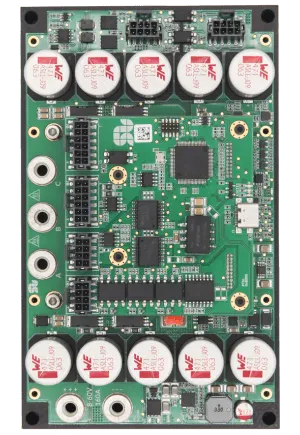
Achieving the right balance between voltage and current requires a reliable motor control solution. SOLO Motor Controllers regulate voltage and current in closed loop, so the drive holds the target speed and torque instead of leaving them to swing with the load. You can also watch both values live while the motor runs, which is the fastest way to spot an unbalanced setup before it turns into heat.
Conclusion
Understanding the effects of voltage and current on motor control and performance is essential for optimizing industrial applications. Proper management can improve motor efficiency, enhance performance, and prolong equipment life. However, improper voltage and current handling may lead to overheating, energy waste, and poor performance.
Want to see voltage and current on your own motor? With the SOLO Motion Terminal you can monitor bus voltage and phase current in real time while you tune. To run the loop that keeps them balanced, browse the full controller range, such as the SOLO Uno for compact setups or the SOLO Mega for higher power.
Products in this article

Related articles

Python on Raspberry Pi: Production Motor Control Tips with SOLO
Production tips for Python motor control on Raspberry Pi with SOLO: SoloPy setup, robust serial/CAN, threading, error recovery and reliable deployment.

EtherCAT Motor Control with the SOLO SOM
How EtherCAT motor control works with the SOLO SOM: CoE and CiA 402, distributed clocks, cyclic synchronous modes and wiring a deterministic servo network.

Cogging Torque vs Torque Ripple: What Is the Difference
Cogging torque vs torque ripple explained: what causes cogging, how it differs from torque ripple, when each matters, and how FOC and design reduce them.
