


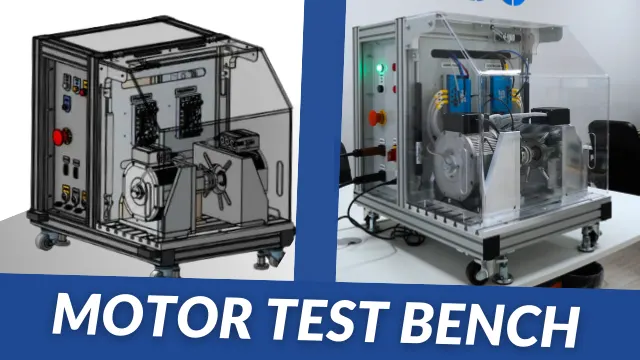
Portable Electric Motor Test Bench
A test bench is an assembly or system designed to test the functionality and performance of a motor or motor controller under various conditions. It simulates
SOLO MINI is another member of the family of SOLO Motor controllers, it has all the Hardware and Software features of SOLO UNO in a smaller form factor (74mm*63.6mm) with less power rating of 500Watts, the specifications of SOLO MINI are as below:

Control Specifications
Supported Motor Types
DC (DC Brushed)
BLDC (Brushless DC)
PMSM (Permanent Magnet Synchronous Motor, AC Brushless)
ACIM ( AC Induction Motor)
Control Modes
Speed Control
Torque Control
Position Control
Control Types
Sensor-based
Sensor-less
Control Loops Update Rate
Torque Loop: 7µs
Speed Loop: 500µs
Position Loop: 500µs
Controller Tunings
Torque Controller: Automatic
Speed Controller: Manual
Position Controller: Manual
Electrical Specifications
Supply Voltage Range
8-40V
Max. Continuous Current
20A
Peak Current
80A
Output PWM Frequency
8kHz to 80kHz
Continuous Max. Power
500W
Input Command Signals
PWM [5-200kHz]
Analogue [0-5V]
UART, USB, CANopen
Mechanical Specifications
Form Factor
74mm*63.6mm
Weight
69 grams
No matter how skilled, we all make mistakes. In hardware projects, this means losing time and money. We designed SOLO with safety in mind. We offer protection against reverse polarity connections, output short-circuits, over-voltage, or under-voltage on your main supply input (BUS) and over-current consumptions. You now use motors with fewer worries.
SOLO is easy but not simple. The experienced user will find many advanced functionalities. From sending packets through USB, UART, or CAN to use industrial state of the art technologies like Closed-loop and Open-loop, Sensored, Sensor-less, and Field-oriented control.
Simply control the speed, torque, and position of your motor’s shaft separately. Enjoy these features while SOLO automatically detects the motor’s parameters and self-tunes.
SOLO features closed-loop sensorless speed control for DC brushed, Brushless DC, Permanent Magnet Synchronous and AC Induction motors. Using this feature the user will be able to keep the speed of their motors constant regardless of the load applied on the shaft of the motor as long as the motor itself can sustain it.
In sensorless mode, there’s no need to connect any sort of position sensors like Hall-Effect sensors or Encoders, and this will reduce the cost and wiring of the final products alongside with much higher reliability gained due to relying only on the electrical motor itself than anything else.
SOLO in this mode offers you a very robust experience even in very harsh conditions like below when the direction of the Brushless DC motor changes abruptly but as can be seen SOLO could fix the speed on both directions immediately with a very low error margin.

This feature enables SOLO to directly control the Torque of DC brushed, Brushless DC and Permanent Magnet Synchronous Motors directly and independently from the speed using Field oriented Control! In simple language in this mode SOLO keeps the exerted Torque of the Motor constant at all times regardless of the amount the load on the shaft of the Motor. This feature will enable users to go on with force control, impedance control and even having instant torque feature on their electric vehicles, Ebikes, Escooters and so on.
The Torque control is done totally automatically in SOLO and the users by pushing down a button can immediately start utilizing it. In the image below you can see how SOLO kept the torque constant in a PMSM motor while the load was kept varying constantly.

The sensorless methods are known to be based on approximations and estimations, which tends to degrade their accuracy in comparison with sensor-based methods, despite these facts, in SOLO you can find a very accurate sensorless estimator for speed and Angle which also is active, valid and functional during zero speed.

SOLO, despite having all the features for sensorless control, offers also the sensor-based controls for highly sensitive and accurate systems, The control can be done using quadrature encoders or Hall sensors mounted on the motors.

Thanks to this feature SOLO will be very efficient, robust and able to control the torque and speed with nested torque, speed and position controllers, within the heart of FOC, SOLO utilizes the SVPWM which puts the 3-phase motors into a higher dimension of efficiency and performance.

Since each electrical motor is different with the other, SOLO identifies most of the required parameters of each motor itself in less than a second, this makes you able to control your motor either in Torque or Speed control mode in the simplest and fastest way possible. In the simplest form, you can control either of the torque or speed of your motor with a single potentiometer. Of course you can use more advanced features like sending PWM or Analogue voltages or even sending packets through UART, CAN or USB which are existing on SOLO, to control each of the features or read the motor feedback in real-time.
SOLO actively keeps track of its own temperature and tries to keep the board temperature at 80 ℃ fixed during harsh conditions by giving the maximum possible current outside while trying to keep the temperature in range, if anything goes out of control the board will shut itself down at 85 ℃ to keep the board and the components safe.


A test bench is an assembly or system designed to test the functionality and performance of a motor or motor controller under various conditions. It simulates
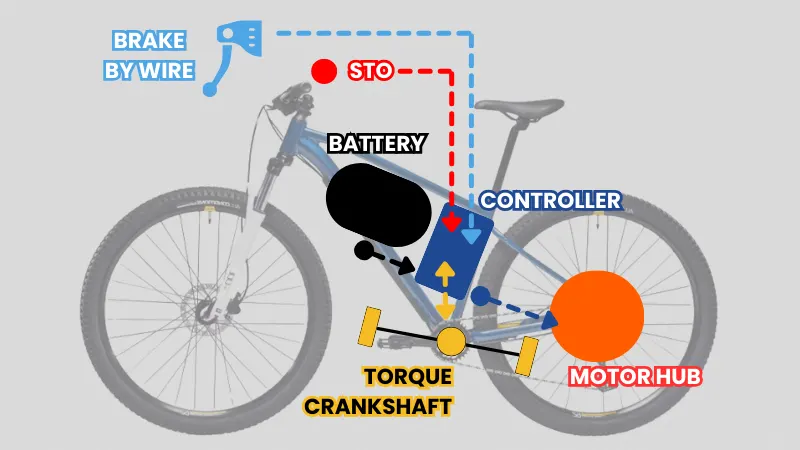
A complete guide to e-bikes, covering sustainability, design, and the technical aspects of building and riding an electric bike.
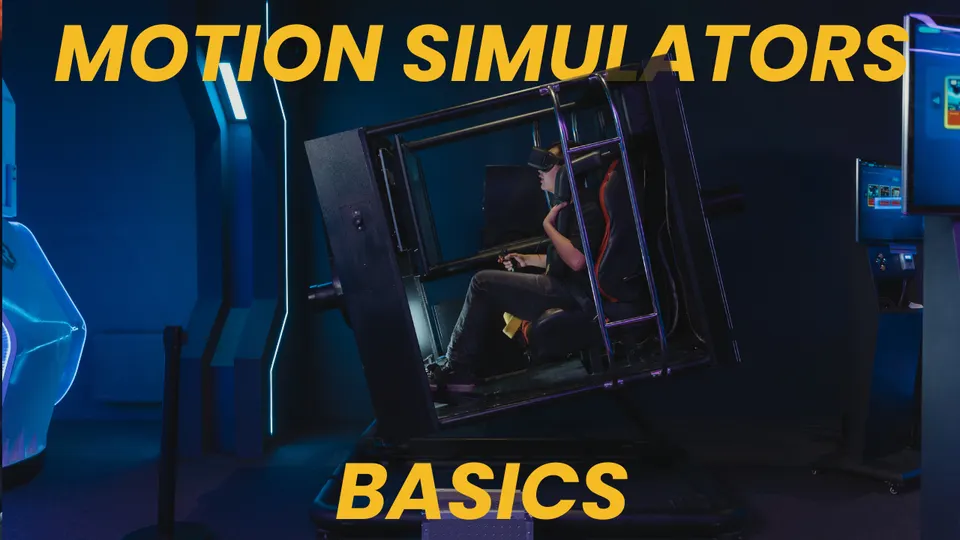
This article explores key concepts like Degrees of Freedom (DOF) and their applications, highlighting implementation, advantages, and limitations.

Discover our High-Performance Motor Controllers, Test Benches, and Services trusted worldwide.