
Back-EMF in Electric Motors: What It Is and Why It Matters
Back-EMF is the voltage a motor generates as it spins, and it grows with speed. In electric motors, this self-induced voltage opposes the applied voltage, so it shapes how the motor draws current, how much torque it can deliver, and how fast it can go. Understanding back-EMF is key to controlling speed accurately, improving efficiency, and protecting the drive electronics.

What is Back-EMF?
Back-EMF (Back Electromotive Force) is the voltage generated by an electric motor as it rotates. This voltage is the result of Faraday’s Law of Induction, where a rotating coil in a magnetic field induces a voltage. In essence, when the motor’s rotor spins, it creates its own voltage that opposes the original applied voltage, hence the term “back” EMF.

Back-EMF is directly related to motor speed. The faster the motor spins, the greater the back-EMF generated. This relationship is critical for motor controllers, as it helps determine the motor’s speed and performance. Properly managing back-EMF can lead to significant efficiency gains and enhanced control over the motor’s operation.
How Does Back-EMF Affect Electric Motor Performance?
Back-EMF can be beneficial and problematic, depending on the context and control strategy. Here’s how it influences electric motor performance:
| Factor | Speed Regulation | Energy Efficiency | Torque Control | Thermal Management |
|---|---|---|---|---|
| Effect of Back-EMF | Acts as a natural speed limiter, helping stabilize speed and prevent overspeeding. | Reduces the net current needed to hold a speed, improving efficiency at higher speeds. | Torque follows current, so higher back-EMF tends to reduce the torque available at high speed. | Managing back-EMF limits excess current draw, cutting heat and extending motor life. |
Disadvantages of Back-EMF in Electric Motors
While back-EMF can aid in motor efficiency, it also presents certain challenges that must be managed:
- Reduced Torque at High Speeds: When the motor spins faster, the back-EMF increases, which can limit the available torque. This can be a disadvantage in applications that demand high-speed torque.
- Complex Control Systems: Effective back-EMF management often requires advanced motor controllers that can adjust based on changing back-EMF levels, increasing system complexity.
- Startup Power Demand: At startup, there is no back-EMF, which means a high initial current draw. This can cause voltage drops or system instability if not properly managed.
- Voltage Spikes: In cases where the motor decelerates quickly, back-EMF can create voltage spikes that may damage components if protective circuits are not in place.
Calculating Back-EMF: Key Equations
The calculation of back-EMF involves several parameters, including motor constants, speed, and magnetic flux. Here’s a basic look at the primary formula:
E = ke × ω
where E is the back-EMF (V), ke is the motor’s back-EMF constant (V per rad/s), and ω is the rotational speed (rad/s). The takeaway: back-EMF scales linearly with speed, which is exactly why a controller can read speed and estimate rotor position from it.
Where:
- ke: The back-EMF constant of the motor (V/rad/s)
- ω: The rotational speed of the motor in radians per second
This simple formula highlights how back-EMF scales with motor speed, emphasizing the need for controllers capable of dynamically adjusting to speed changes.
Controlling Back-EMF with SOLO Motor Controller
SOLO controllers turn back-EMF from a side effect into useful information:
- Sensorless position and speed: instead of fighting back-EMF, SOLO reads it. By tracking the motor’s induced voltage, the controller estimates rotor speed and position without an encoder, which is the basis of sensorless control.
- High-speed operation: as back-EMF rises toward the supply voltage, field weakening keeps the motor accelerating past its rated speed. It is built into SOLO controllers at no extra cost.
- Stable current control: SOLO’s current loop accounts for back-EMF so torque stays predictable across the speed range.
- Protection: built-in safeguards limit the voltage surges that can appear during fast deceleration.
You configure all of this from the free SOLO Motion Terminal, with no extra license.
How Back-EMF Relates to Motor Control
In modern motor control, back-EMF is not just a limit to work around. It is also a signal to read. Two ideas explain most of what a controller does with it.
As a source of information. Because back-EMF grows with speed and its shape follows the rotor’s position, a controller can generally estimate both by watching the motor’s own voltage. This is the foundation of sensorless control: no encoder needed, the motor tells the controller where it is. As a rule, this works best above a low minimum speed, since at standstill the back-EMF is too small to read.
As a speed ceiling. As the motor spins faster the back-EMF rises toward the supply voltage. Once the two are close there is little voltage headroom left to push more current, so the motor cannot accelerate further. Field weakening gets around this by reducing the effective magnetic field, which lowers back-EMF and frees the motor to spin faster, trading some torque for speed.

Practical Applications: How Back-EMF Management Enhances Efficiency
Electric Vehicles (EVs)

In electric vehicles, managing back-EMF is essential for maximizing range and maintaining acceleration performance. At high speeds, back-EMF can significantly reduce torque.
Industrial Automation

In industrial machinery, speed and torque control are crucial for precision.
Conclusion:
Understanding and managing back-EMF is essential for anyone looking to get the most out of electric motors. A controller that can adapt to back-EMF changes ensures smooth speed transitions, power efficiency, and robust protection against potential surges.
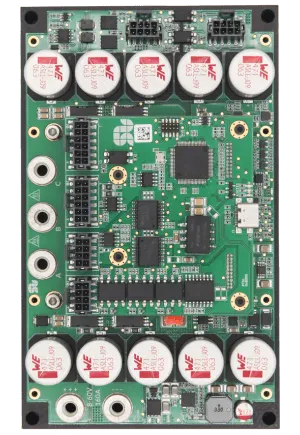
Want a controller that reads back-EMF instead of fighting it? SOLO controllers use back-EMF for sensorless position estimation and support field weakening out of the box. See the SOLO Uno and the SOLO Mega, or browse the full controller range.
Products in this article

Related articles

Python on Raspberry Pi: Production Motor Control Tips with SOLO
Production tips for Python motor control on Raspberry Pi with SOLO: SoloPy setup, robust serial/CAN, threading, error recovery and reliable deployment.

EtherCAT Motor Control with the SOLO SOM
How EtherCAT motor control works with the SOLO SOM: CoE and CiA 402, distributed clocks, cyclic synchronous modes and wiring a deterministic servo network.

Cogging Torque vs Torque Ripple: What Is the Difference
Cogging torque vs torque ripple explained: what causes cogging, how it differs from torque ripple, when each matters, and how FOC and design reduce them.
