
Zero Speed Full Torque (ZSFT): Sensorless Control from Standstill
Introduction
Standard sensorless control reads the motor’s back-EMF, and back-EMF drops to zero when the rotor stops. So at 0 rpm a classic sensorless drive sees nothing, and it cannot make torque at the moment you need it most: the start. Zero Speed Full Torque (ZSFT) solves that. It holds full torque from standstill, with no encoder and no hall sensors.
This article explains what ZSFT is, when it works well, and how to turn on zero speed sensorless control in SOLO Motion Terminal. By the end you will know if your motor is a good fit and how to verify torque at 0 rpm.
Why Standard Sensorless Fails at Zero Speed
Most sensorless methods estimate the rotor angle from back-EMF, the voltage a spinning motor generates on its own windings. That voltage is proportional to speed. At high speed the signal is strong and easy to track. As speed falls, the signal shrinks. At 0 rpm it is gone.
With no back-EMF, the estimator has nothing to lock onto. The drive loses the rotor angle, so it cannot place the current correctly, and torque collapses. This is why a plain back-EMF drive struggles to start under load and why it can slip or stall near standstill. For the underlying physics, see back-EMF, and for the general method see sensorless control.
Takeaway: back-EMF sensorless is great at speed and blind at zero speed, because the signal it needs disappears when the motor stops.
What Is Zero Speed Full Torque (ZSFT)
ZSFT is a sensorless method that finds the rotor angle without relying on back-EMF, so it works down to 0 rpm. That lets the drive hold rated torque at standstill and start cleanly under load, with no position sensor on the shaft.
The Idea: Tracking Saliency Instead of Back-EMF
Instead of listening for the motor’s own voltage, ZSFT injects a small high frequency signal on top of the normal current. The motor’s response to that signal depends on rotor position, because the inductance of the windings changes with the angle of the magnets. This change in inductance with angle is called saliency.
By measuring how the motor reacts to the injected signal, the algorithm reads the rotor angle directly, even when the shaft is not moving. Saliency does not depend on speed, so the angle stays valid at 0 rpm. To understand the property the method leans on, see saliency ratio.
Where ZSFT Helps (and Where It Does Not)
ZSFT needs a motor with enough saliency to track. Interior permanent magnet motors (IPM, magnets buried in the rotor) and many reluctance-type motors have clear saliency, so they generally work well.
Surface-mount PMSM motors (magnets glued to the rotor surface) have low saliency, so the injected signal carries a weaker position cue. ZSFT can still run on some of them, but the holding torque and robustness are usually lower than on a salient motor. If your motor has almost no saliency, an encoder or hall sensor is the safer path at zero speed. The sensorless BLDC and PMSM overview covers how motor type affects sensorless behavior.
Takeaway: ZSFT trades back-EMF for saliency tracking. More rotor saliency means stronger, more reliable torque at standstill.
ZSFT vs Back-EMF Sensorless vs Encoder
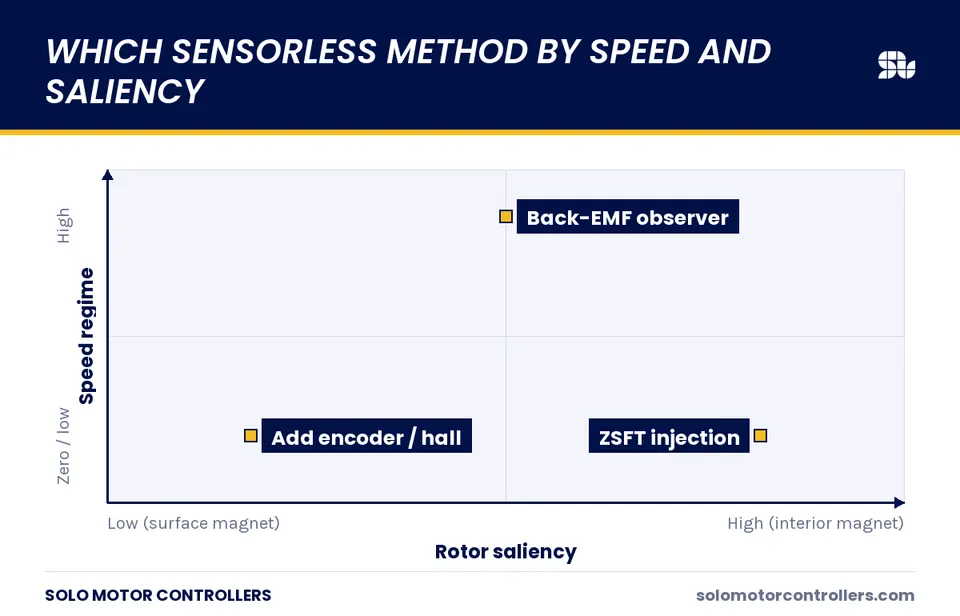
Each feedback method has a speed range where it shines. The table below compares the three on what matters most for a start-from-stop application.
| Method | Works at 0 rpm | Torque at standstill | Hardware cost | Best speed range |
|---|---|---|---|---|
| ZSFT (HF injection) | Yes | Full, on salient motors | No sensor | Zero and low speed |
| Back-EMF sensorless | No | None | No sensor | Medium and high speed |
| Encoder / resolver | Yes | Full, any motor | Sensor + wiring | Full range |
ZSFT and back-EMF sensorless are not rivals. A complete sensorless drive uses ZSFT at low speed and switches to back-EMF at higher speed, so you get torque at standstill and clean tracking at speed, with no sensor at all. For a full head-to-head between sensored and sensorless feedback, see sensor vs sensorless.
Setting Up Zero Speed Sensorless in Motion Terminal
Getting torque at 0 rpm is mostly about a correct setup. The steps below follow the normal order in Motion Terminal.
Prerequisites: Motor Identification and Feedback Mode
ZSFT relies on accurate motor parameters, above all the inductance values that carry the saliency information. So run motor identification first and let SOLO measure the motor before you enable injection. A motor that was never identified, or identified poorly, will give a weak or wrong angle at standstill.
Then set the feedback mode to sensorless. With identification done and sensorless feedback selected, the drive has what it needs to estimate the rotor angle from the injected signal.
Enabling ZSFT / Injection
In sensorless mode, enable the zero speed option so the drive turns on high frequency injection at low speed. This is the parameter that lets the controller hold the angle down to 0 rpm.
Start with the default injection settings. Fine tuning the injection amplitude and frequency for a specific motor is its own topic, and changing them blindly can make the angle noisy. Keep the defaults for the first run and only tune later if you need more holding torque or smoother low-speed behavior.
Verifying Torque at Standstill
Confirm the result before you trust it in the machine. Command a small torque or a position hold at 0 rpm, then watch the live signals in the Motion Terminal monitor. Check that Iq (the torque-producing current) follows your command and that the estimated position stays steady while the shaft is blocked or lightly loaded.
If the rotor holds against a load and Iq tracks the target with the shaft stopped, ZSFT is working. If the angle drifts or the motor cannot hold, recheck identification and motor saliency before touching injection settings.
Takeaway: identify first, select sensorless, enable injection, then verify Iq and position at 0 rpm. Defaults usually get you holding torque on the first try.
Transition: From Zero Speed to High Speed
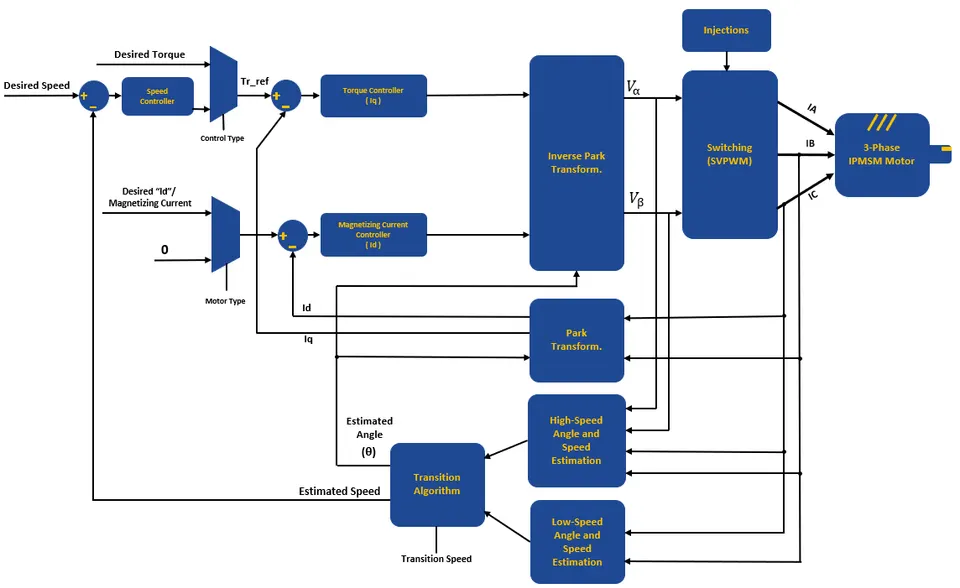
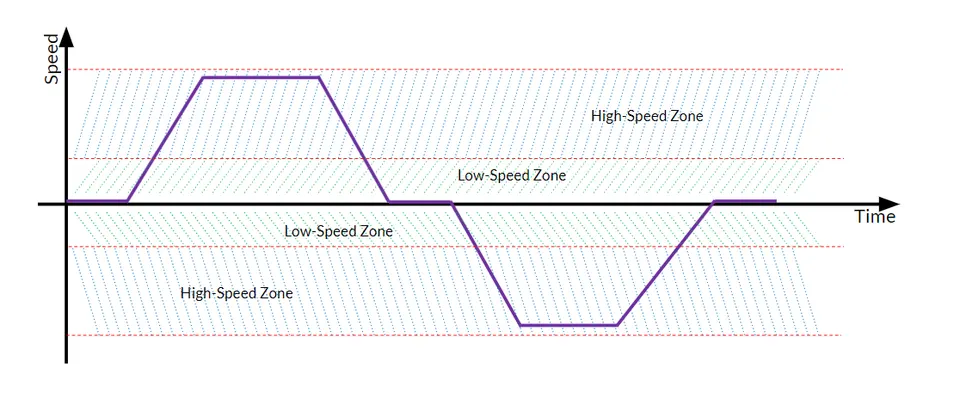
ZSFT is built for standstill and low speed. As the motor speeds up, the back-EMF grows and becomes a cleaner, lower-loss source of the rotor angle than injection. So a full sensorless drive hands over from ZSFT to a back-EMF observer once speed is high enough.
SOLO manages this crossover for you, so the drive stays in closed loop through the whole range. The high-speed side, including the observer and its filter, is covered separately, so this article stays on the zero-speed part. The chart below shows the speed zones a ZSFT-based drive moves through.
Pros, Cons & Trade-offs
ZSFT buys you torque at zero speed, but like any method it has costs. Weigh them against your application.
Pros
- Full torque at 0 rpm with no encoder or hall sensor, so you start under load cleanly.
- Lower hardware cost and wiring, since there is no sensor on the shaft to mount and cable.
- No sensor failure point in harsh, dusty, or high-vibration environments.
Cons
- Needs saliency. Low-saliency surface PMSM motors give weaker, less robust holding torque.
- Injection adds a small high frequency signal, which can create slight extra audible noise or loss at standstill.
- Setup is more sensitive. Good motor identification matters more than with a sensor.
Trade-offs
- For low-speed, high-precision positioning on a low-saliency motor, an encoder is usually the more robust choice, at the cost of the sensor.
- For most salient PMSM and IPM drives that need torque from a stop, ZSFT removes the sensor with little practical downside.

How SOLO Supports Zero Speed Sensorless Control
SOLO controllers support ZSFT so you can hold torque at 0 rpm without a sensor, on DC, BLDC, PMSM, and AC induction motors where saliency allows it. Automatic motor identification handles the inductance measurement that ZSFT depends on, which keeps the setup short.
You configure and verify everything in SOLO Motion Terminal: run identification, select sensorless feedback, enable injection, then watch Iq and position at standstill in the monitor. The same drive keeps the motor in closed loop as it speeds up, so you get one tool from zero speed to full speed.
Conclusion
Standard back-EMF sensorless control goes blind at 0 rpm, because the signal it reads scales with speed. ZSFT gets around this by injecting a high frequency signal and tracking the motor’s saliency, so it reads the rotor angle at standstill and holds full torque with no sensor. It works best on salient motors such as IPM and many PMSM types, and weaker on low-saliency surface PMSM. In Motion Terminal the path is short: identify the motor, set sensorless feedback, enable injection, then confirm Iq and position at zero speed. To try zero speed sensorless control on your own motor, set it up in SOLO Motion Terminal.
FAQ
Can a motor hold full torque at zero speed without an encoder?
Yes. With ZSFT (zero speed full torque), the drive injects a high frequency signal and reads the rotor angle from the motor’s saliency, not from back-EMF. Because saliency does not depend on speed, the angle stays valid at 0 rpm, so the motor can hold rated torque at standstill with no encoder, as long as it has enough saliency.
Does ZSFT work on any motor?
Not equally. ZSFT needs magnetic saliency to track. Interior permanent magnet (IPM) and many salient PMSM motors generally work well. Surface-mount PMSM motors have low saliency, so holding torque and robustness are usually lower. A motor with almost no saliency is better served by an encoder at zero speed.
What is high frequency injection in sensorless control?
It is the technique behind ZSFT. The controller adds a small high frequency voltage or current on top of the normal drive signal, then measures how the motor responds. Because the response changes with rotor position through saliency, the controller recovers the angle, even when the shaft is not turning.
When should I use an encoder instead of ZSFT?
Choose an encoder when the motor has very low saliency, or when you need the highest position accuracy and robustness at low speed regardless of motor type. An encoder works on any motor at 0 rpm, at the cost of the sensor and its wiring. For salient motors that mainly need torque from a stop, ZSFT often removes that sensor with little downside.
Related articles
Tuning Sensorless Injection (Amplitude and Frequency) on SOLO
How to tune the ZSFT injection amplitude and frequency on SOLO for stable, low-noise sensorless control at standstill and low speed. A Motion Terminal guide.
High Speed Observer (HSO) Sensorless: How It Works and Filter Tuning
How the High Speed Observer drives sensorless control at speed, and how to tune the observer filter cutoff on SOLO for smooth, stable high-RPM operation.
Closed-Loop vs Sensorless: Choosing Your Feedback Strategy
A decision guide to choosing your motor feedback: sensorless vs encoder vs hall. Match the feedback mode to your speed range, torque and accuracy needs on SOLO.
