
Closed-Loop vs Sensorless: Choosing Your Feedback Strategy
Introduction
Pick the wrong feedback mode and you pay for it twice: once when the motor will not hold torque or position the way you need, and again when you retune the whole drive after switching. The feedback strategy is the first real decision in a project, not a detail you settle later.
This is a decision guide. It helps you match the feedback mode to your application before you wire anything. We will not repeat the full technical head-to-head here. For the detailed comparison of how each method works, see sensor vs sensorless control. What you get below is a short framework: four questions, a decision table, and the trade-offs that usually settle the choice.
The Three Options in One Minute
You have three practical ways to give a motor controller feedback. Here is each one in a single line.
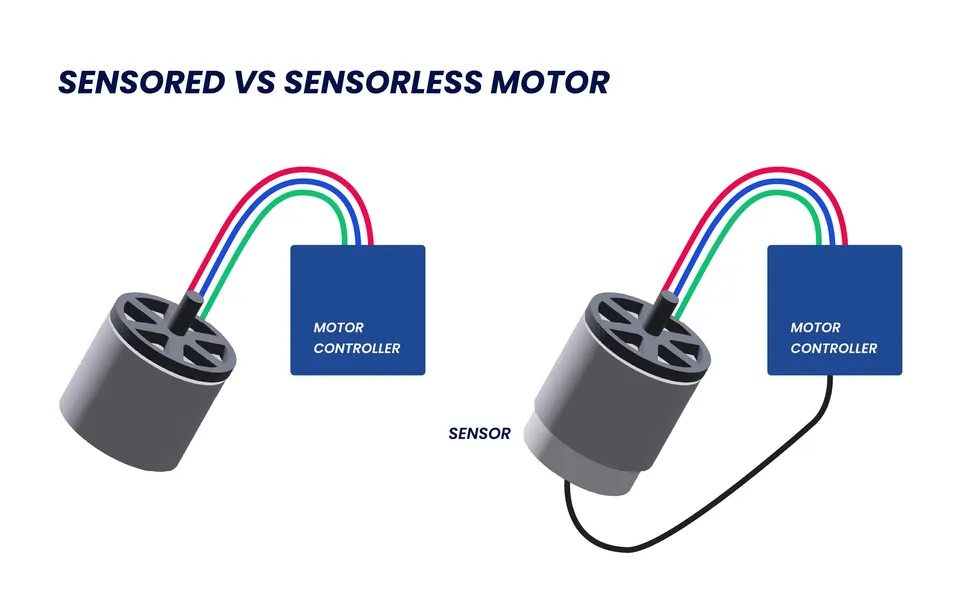
- Sensorless: the controller estimates rotor position from motor voltages and currents, using the back EMF and an observer. No feedback wiring on the motor. See how back EMF works.
- Encoder: a dedicated sensor on the shaft reports position directly, with high resolution and repeatable accuracy. It needs wiring and a clean mounting.
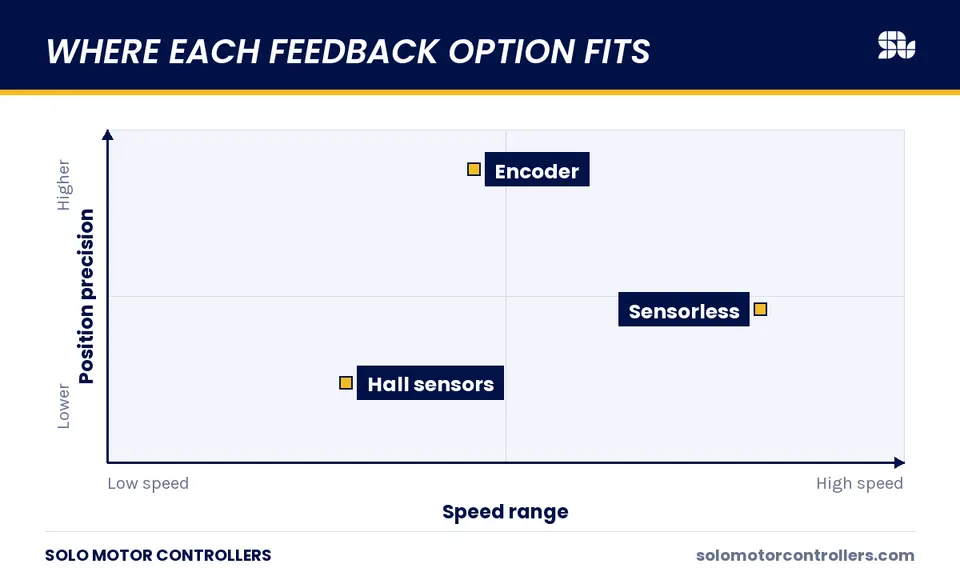
- Hall sensors: three digital sensors give coarse position, enough for reliable commutation and torque from standstill at low cost.
Each one trades wiring and cost against accuracy and low-speed behavior. The next four questions tell you which trade matters for your case.
Takeaway: sensorless saves wiring, an encoder buys accuracy, Hall buys low-speed torque cheaply.
The Questions That Decide
You do not need to weigh every spec. Four questions decide the feedback mode for most projects. Answer them in order.
Do You Need Torque at Zero Speed?
This is the sharpest divider. A standard sensorless method relies on back EMF, and back EMF is near zero when the motor is barely moving. So plain sensorless struggles to hold full torque at zero speed or very low RPM. If your application must produce torque from a dead stop, under load, you need either an encoder, Hall sensors, or a sensorless method built for standstill.
SOLO controllers support a zero-speed full-torque sensorless mode that injects a high-frequency signal to find the rotor at standstill, so sensorless is not always ruled out here. But if torque at zero speed is critical and constant, a position sensor is the safe default.
Takeaway: if you must hold torque at a standstill, lean toward an encoder or a standstill-capable mode, not plain back-EMF sensorless.
What Is Your Speed Range?
Sensorless is strongest in the mid-to-high speed range, where back EMF is large and clean. A high-speed observer tracks the rotor well once the motor is spinning, which makes sensorless a natural fit for fans, pumps, spindles, and drone propellers that live at high RPM. At very low speed the signal weakens, as covered above. Map your duty cycle: if the motor spends most of its time spinning fast and rarely sits at zero, sensorless usually fits.
Takeaway: wide or high-speed ranges favor sensorless; long dwells at low speed favor a sensor.
How Much Positioning Accuracy?
If you need to land the shaft on a precise angle, repeatably, an encoder is the answer. Resolution and repeatability are what encoders are built for, and no estimation method matches a good encoder for positioning. Hall sensors give only coarse position, fine for commutation but not for precise moves. Sensorless estimates position well for speed and torque control, yet it is not the tool for tight closed-loop positioning.

Takeaway: tight, repeatable positioning means an encoder; speed and torque control can stay sensorless.
Cost, Wiring and Reliability Constraints?
Every sensor on the shaft is a part to buy, a cable to route, and a connector that can fail. Sensorless removes all of that, which lowers cost and improves reliability in dirty, hot, or high-vibration environments where a sensor cable is a weak point. That is why sealed pumps and many industrial fans run sensorless. Hall sensors are cheap and rugged but still need three wires. Encoders cost the most and are the most sensitive to mounting and noise.
Takeaway: if wiring, cost, or a harsh environment is the constraint, sensorless usually wins.
Decision Table (Match Use-Case to Feedback)
Here is the short version. Find the row closest to your application, then confirm it against the four questions above. For the full method-by-method comparison, see sensor vs sensorless control.
| Use case | Recommended feedback | Why |
|---|---|---|
| Fan, pump, blower (high speed, no standstill load) | Sensorless | Strong back EMF at speed, no wiring, runs in sealed or harsh settings |
| Drone or e-bike propulsion | Sensorless | High RPM, weight and wiring matter, rarely holds torque at zero |
| Robotic joint, actuator (precise position) | Encoder | Repeatable angle and tight positioning need a real sensor |
| Conveyor, traction from a stop (torque at zero speed) | Hall or encoder | Must produce torque before back EMF builds up |
| Low-cost BLDC (simple commutation) | Hall | Cheap, rugged, enough position for smooth commutation |
| Spindle, high-speed tool | Sensorless | Lives at high RPM where estimation is accurate |
| Cost-sensitive, harsh environment | Sensorless | No sensor to fail, lowest part count |
Takeaway: most high-speed and harsh-environment jobs go sensorless; precise positioning and torque-from-stop jobs go to a sensor.
How to Set the Chosen Mode on SOLO
On SOLO you do not rewire the controller to change feedback strategy. You select the feedback mode in software. In the Motion Terminal, you set the motor type and then choose the feedback method, sensorless, Hall, or encoder, in the configuration. For an encoder or Hall setup you also run a one-time calibration so the controller learns the sensor offset. For sensorless you set the observer parameters that fit your speed range and load.
The point is that the choice is a setting, not a redesign. You can start sensorless to validate the motor, then add an encoder later if a new use case needs tight positioning, without changing the controller hardware.
Takeaway: feedback mode is a software setting on SOLO, with a quick calibration step for sensor modes.
Pros, Cons & Trade-offs
No feedback mode is best for everything. The right call balances accuracy, low-speed torque, wiring, and cost against what your application actually needs.
| Feedback | Pros | Cons | Best when |
|---|---|---|---|
| Sensorless | No sensor wiring, lower cost, robust in harsh settings, ideal at high speed | Weak at zero and very low speed with plain back EMF, not for tight positioning | High or wide speed range, cost and reliability matter |
| Encoder | Highest accuracy and repeatability, true positioning, works at all speeds | Costs more, needs wiring and careful mounting, sensitive to noise | Precise position, repeatable moves, servo work |
| Hall | Cheap, rugged, gives torque from standstill | Coarse resolution, not for fine positioning, still needs three wires | Simple, low-cost BLDC commutation |
The common mistake is over-specifying. Teams add an encoder out of habit when a high-speed pump would run fine sensorless, paying for wiring and a failure point they do not need. The opposite mistake is choosing sensorless for a job that must hold torque at zero speed, then fighting the motor at startup. Match the mode to the duty cycle, not to a default.
How SOLO Helps You Choose and Switch Feedback Modes
SOLO controllers support all three feedback strategies on the same hardware: sensorless, Hall, and encoder. You select the mode in the Motion Terminal, so you can try one strategy, measure the result, and switch to another without swapping the controller. That helps when requirements change between a prototype and production, or when one product line spans both high-speed and positioning jobs.
SOLO also covers the harder corners of sensorless, like holding torque near zero speed and tracking the rotor at high speed, so you keep more applications on a single platform. If you want a controller to evaluate both sensorless and sensored modes, the SOLO UNO is a practical place to start.
Conclusion
Choosing a feedback strategy comes down to four questions: torque at zero speed, speed range, positioning accuracy, and cost or wiring constraints. Need precise position or torque from a dead stop, pick an encoder or Hall. Run mostly at speed and want less wiring, pick sensorless. The good news is that on SOLO the feedback mode is a setting you can change later, so you are not locked in by your first guess. To set up and compare modes on real hardware, open the SOLO Motion Terminal and try them on your motor.
FAQ
Sensorless or encoder: which should I choose?
Choose an encoder when you need precise, repeatable positioning or torque at a standstill. Choose sensorless when the motor runs mostly at speed and you want lower cost, less wiring, and better reliability in harsh conditions. If you are unsure, map how much time the motor spends near zero speed; long dwells there push you toward a sensor.
Can I switch feedback mode later without re-tuning?
You can switch the mode in software on SOLO, but each mode has its own tuning. Sensorless uses observer settings, and encoder or Hall modes need a one-time calibration of the sensor offset. So you will redo some tuning when you switch, but you do not change the controller hardware.
Is sensorless less accurate than an encoder?
For positioning, yes. An encoder reports rotor angle directly with high resolution, while sensorless estimates it, so a good encoder is more accurate for precise moves. For speed and torque control at mid-to-high speed, sensorless is accurate enough for most applications, which is why it is common in pumps, fans, and drives.
Tags:FeedbackMotion TerminalSensorless
Products in this article

Related articles
Tuning Sensorless Injection (Amplitude and Frequency) on SOLO
How to tune the ZSFT injection amplitude and frequency on SOLO for stable, low-noise sensorless control at standstill and low speed. A Motion Terminal guide.
High Speed Observer (HSO) Sensorless: How It Works and Filter Tuning
How the High Speed Observer drives sensorless control at speed, and how to tune the observer filter cutoff on SOLO for smooth, stable high-RPM operation.
Zero Speed Full Torque (ZSFT): Sensorless Control from Standstill
How SOLO holds full torque at zero speed without sensors. What ZSFT is, when to use it, and how to set up zero speed sensorless control in Motion Terminal.
