
EV / E-Mobility Motor Validation: Test Bench Setup
Introduction
A single traction-motor field return can cost a carmaker tens of thousands of euros once you add the recall logistics, the warranty claim, and the lost trust. A bench retest before launch costs a fraction of that. The job of an EV motor test bench is to catch the problem on your floor, not on the road.
This guide shows you how to set up a bench to validate an EV or e-mobility traction motor. You will see how to size the power envelope, emulate the battery bus, load the motor with a dyno, and run a real drive cycle instead of a few static points.
Why EV Motor Validation Needs a Dedicated Bench
A traction motor lives a harder life than a fixed-speed industrial drive. It makes high torque at low speed when the vehicle pulls away, spins to high RPM on the highway, and switches between the two thousands of times a day. A generic bench built for one steady operating point will not stress that range.
The mission profile is the difference. EV validation has to cover repeated transients: acceleration, regen braking, hill holds, and thermal soak in stop-and-go traffic. Each one loads the motor, the magnets, and the bearings in a different way. You need a bench that can follow a load profile, not just hold a constant brake torque.
There is also the inverter and the high-voltage bus to think about. The motor under test draws from a DC link that can sit at 400 V or 800 V, and it pushes energy back during regen. That changes how you load, measure, and protect the setup. For the basics of what any bench includes, see our overview of an electric motor test bench.
Takeaway: an EV bench has to reproduce the full traction duty cycle, not a single point.
Defining the EV Test Envelope
Before you buy or build anything, write down the envelope your motor actually needs. Three numbers frame it: power and torque, the DC bus, and the duty cycle.
Power, Torque and Speed for Traction Motors
Start with the peak and continuous torque, the maximum speed in RPM, and the DC current the motor draws at peak. Traction motors usually have a large gap between peak and continuous, because peak torque is only available for short bursts before thermal limits kick in. Size the bench to both numbers, not the average.
For example, a 6 kW e-mobility motor might peak at 30 Nm and 8000 RPM, while its continuous rating sits near 12 Nm. A bench frame and dyno rated above the peak, with around 20% headroom on torque and speed, leaves room to test that burst and your next motor too. A bench that only fits today’s smallest motor blocks your roadmap.
Bus Voltage and Battery Emulation
A traction motor behaves differently at 60% state of charge than at 100%, because the DC bus voltage sags as the pack drains. To validate the motor across its real operating range, you feed it from a battery emulator, a programmable DC source that holds a target voltage and sources or sinks current like a real pack. That lets you test at the top and bottom of the voltage window without cycling a physical battery.
The emulator also has to absorb regen current when the motor brakes, or you need somewhere to dump that energy. We cover that under loading below.
Duty Cycles and Drive-Cycle Profiles
The point most generic benches miss is that a traction motor is validated against a drive cycle, not a list of static points. A standard cycle like WLTP, or your own custom profile, gives a time series of speed and torque demand. The bench should replay that profile and log every channel along the way.
| Test input | What it drives on the bench | Why it matters for EV |
|---|---|---|
| Static operating points | Hold a fixed speed and torque | Baseline efficiency and torque accuracy |
| WLTP / drive cycle | Time series of speed and torque demand | Real thermal and efficiency behavior over a trip |
| Custom mission profile | Your own acceleration, regen, and soak pattern | Matches the vehicle the motor ships in |
Tracking the full load profile is what separates real validation from a spot check. Static points tell you the motor works once. A drive cycle tells you it survives a thousand trips.
Takeaway: validate against a drive cycle, because a traction motor never runs at one point for long.
Setting Up the Loading System
The loading system is the dynamometer, or dyno, that applies a controllable load to the motor under test. On an EV bench, the load is rarely steady. It follows the drive cycle, so it has to ramp torque up and down in step with the profile.
The key choice is whether the dyno only absorbs energy or can also drive the shaft. For a deep comparison of active, passive, and hysteresis dynos, that is a separate topic. Here we focus on the one feature that EV testing depends on most: handling regen.
Regenerative vs Dissipative Loading
A traction motor spends a lot of its life in regeneration, feeding energy back to the bus during braking. Your bench has to handle that energy, and there are two ways to do it.
Dissipative loading burns the energy as heat in a brake or a resistor bank. It is simpler and cheaper, and it works for steady load points. The downside is the heat, and the fact that a pure brake cannot back-drive the motor to test regen behavior.
Regenerative loading uses an active dyno, a second motor that absorbs the energy and returns it to the supply or the battery emulator. For high-power EV benches this matters, because dumping kilowatts as heat every braking event is wasteful and hard to cool. A regenerative setup also lets you test the motor’s own regen torque, which a brake cannot.
Takeaway: for high-power EV work, regenerative loading saves energy and lets you test the regen path itself.
Sensors and Measurement for EV Validation
Your validation is only as trustworthy as your sensors. An EV bench needs accurate mechanical and electrical measurement, plus enough thermal channels to see the motor heat up under load.
Torque, Speed and Position
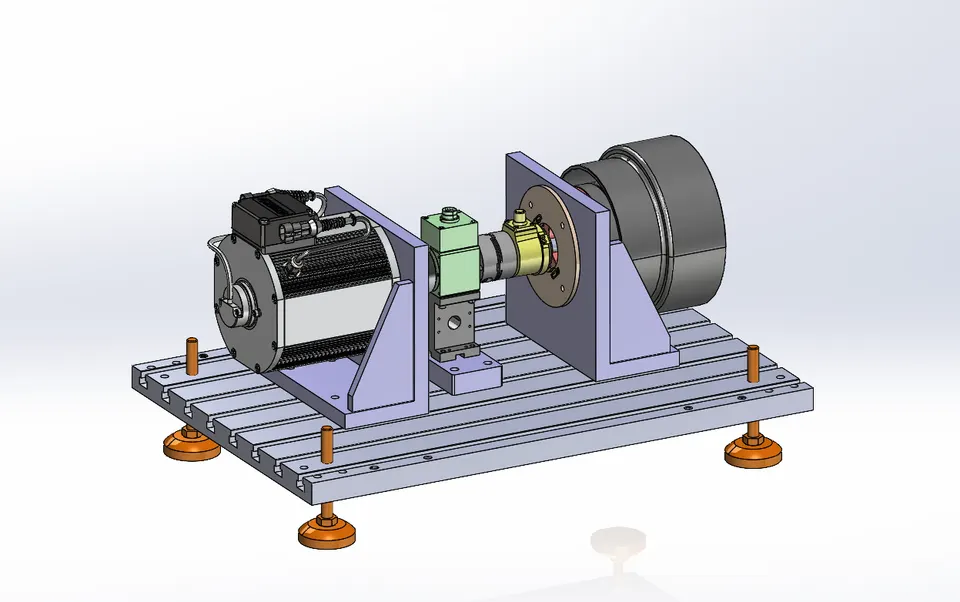
The core mechanical set is a torque sensor in the shaft, a speed and position sensor such as an encoder or resolver, and tight time alignment between them. Check the torque sensor range against your smallest torque, not just the peak. A sensor rated for 100 Nm will measure a 2 Nm regen point poorly, and regen torque is exactly where many EV problems hide.
Electrical Power and Efficiency Points
To get efficiency, you measure electrical power in and mechanical power out at each operating point. That means accurate DC bus voltage and current from the drive, plus the torque and speed from the shaft. The ratio gives you efficiency at that point.
Building the full efficiency map across the torque-speed plane is its own subject with its own method, so we only flag it here. The bench has to capture the raw channels cleanly first, and the map is built from those logs afterward.
Thermal Monitoring
EV motors fail from heat as often as anything else, so you watch winding and magnet temperature during the run. A few thermocouples or PT100 probes on the stator, plus the controller’s own temperature reading, are the minimum. The detailed thermal endurance method, how long to soak and at what points, is a separate plan. For an EV bench, the rule is simple: log temperature on every channel, every cycle, so a slow thermal drift shows up before it becomes a failure.
Takeaway: size your torque sensor to the smallest point you care about, and log temperature continuously.
Control, Protocols and Automation
A good EV bench runs unattended. You set up a drive cycle in the evening and read the log in the morning. That needs a control layer that can command the motor and the dyno together, sequence the test, and record every channel with a timestamp.
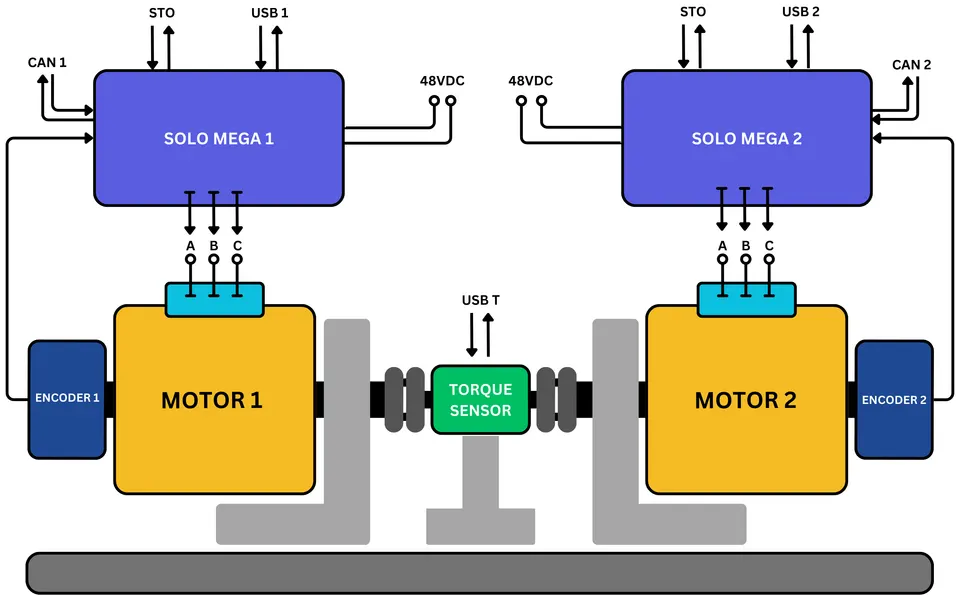
This is where the motor controller matters. A controller that speaks CANopen or EtherCAT drops into an industrial bench and lets you script long runs without a person watching. The same controller can drive the motor under test and the active dyno, coordinate the load profile, and stream torque, speed, current, voltage, and temperature to the log.
Look for configurable pass/fail limits and time-stamped logs you can replay later. Ask one concrete question before you commit: can the software run a full WLTP cycle overnight and log every channel, with no person in the loop? If not, you pay for it in engineer hours.
Takeaway: automation over CANopen or EtherCAT turns an overnight drive cycle into a log you read in the morning.
Safety for High-Voltage Benches
A spinning traction motor stores real kinetic energy, and an 800 V bus stores real electrical energy. Treat both with respect. A high-voltage EV bench needs a hard emergency stop, guarding around the couplings, and electrical isolation between the high-voltage section and the operator.
Add over-speed and over-temperature cutoffs that stop the motor on their own if a limit is crossed, plus a controlled way to handle the regen energy so the bus never runs away. The bench should fail safe: if a sensor drops out, the system shuts the motor down rather than guessing. For how we approach this, see emergency systems on a motor test bench.
Takeaway: high voltage plus stored kinetic energy means the bench must fail safe by default.
How SOLO Sets Up EV Validation Benches
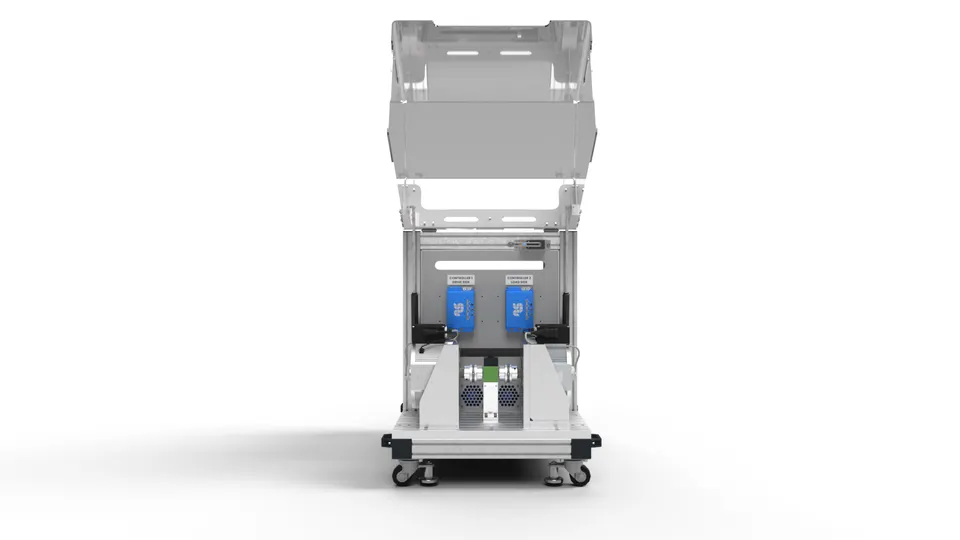
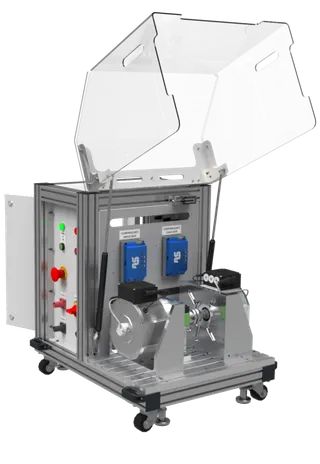
At SOLO we build EV and e-mobility validation benches in the 3 kW to 6 kW class and above, around the same controllers we make. We support active regenerative loading, battery-emulated DC bus, torque and temperature sensing, and drive-cycle automation over CANopen or EtherCAT, and we customize the dyno, sensors, protocols, and report to your motor. That matters because a traction motor that sits outside a standard bench’s fixed envelope becomes a problem you only discover after the purchase. You can see the current SOLO motor test bench and tell us your specs.
Conclusion
Validating an EV traction motor on a bench comes down to a few decisions taken in order. Size the envelope to your peak torque, speed, and DC bus. Emulate the battery so you test across the real voltage window. Load the motor with a dyno that handles regen, and validate against a drive cycle rather than a handful of static points. Add accurate torque and temperature sensing, automate the run over CANopen or EtherCAT, and make the high-voltage setup fail safe. Above all, make sure the bench can be customized to your motor, because a standard envelope rarely fits a traction motor cleanly. If you want a second opinion on a spec, the SOLO test bench page is a good next step.
FAQ
What makes an EV motor test bench different from a generic one?
An EV bench has to reproduce the traction duty cycle: high torque at low speed, high RPM on the highway, and constant transients with regen braking. It also feeds the motor from an emulated high-voltage DC bus and handles the energy the motor returns during regen. A generic bench built for one steady operating point cannot follow that profile.
Do I need regenerative loading to test traction motors?
For high-power EV work, generally yes. A traction motor spends much of its life in regen, so a regenerative dyno lets you test the motor’s own regen torque and avoids dumping kilowatts as heat on every braking event. A simple dissipative brake works for steady load points but cannot back-drive the motor or recover the energy.
Can one bench cover both the EV motor and its inverter?
Often yes. If the bench feeds an emulated DC bus and measures both electrical input and mechanical output, you can validate the motor and its inverter as a unit. You measure power in at the bus and power out at the shaft, which gives you the combined efficiency and lets you see how the pair behaves across the drive cycle.
How do I validate against a drive cycle on a bench?
You load a time series of speed and torque demand, from a standard like WLTP or your own custom mission profile, and the bench replays it while the dyno follows the load. The control software commands the motor and dyno together and logs every channel with a timestamp. That gives you real thermal and efficiency behavior over a full trip, not just a few static points.
Tags:EVMotor ValidationTest Bench
Products in this article
Related articles

Case Study: EV Drivetrain Motor Validation on a SOLO Bench
A case study on validating an EV drivetrain motor on a SOLO test bench: the goals, the setup, the test plan and the results delivered.

Efficiency Mapping a Motor: Method and What It Reveals
How to build a motor efficiency map on a test bench: the measurement method, the torque-speed grid, and what the map reveals about a motor.
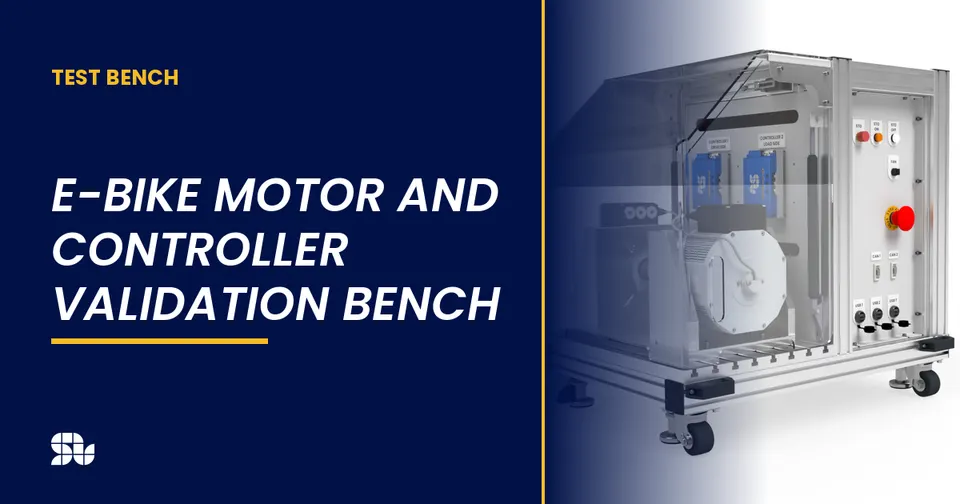
E-Bike Motor and Controller Validation Bench
How to validate an e-bike motor and controller on a bench: torque and cadence, assist profiles, regen and the metrics that matter for e-bikes.
