
How to Choose a Motor Test Bench: A Buyer’s Guide (7 Criteria)
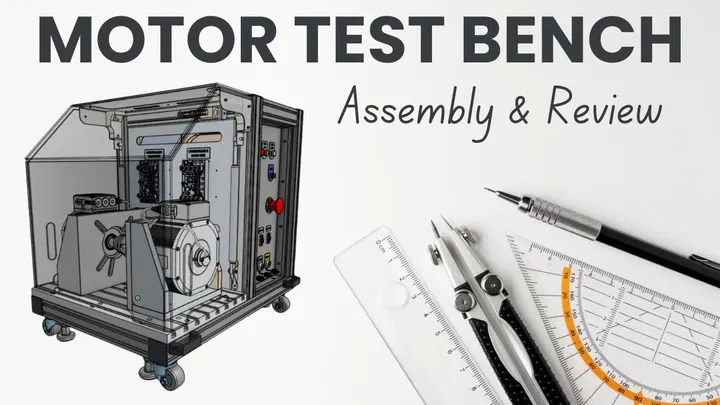
Introduction
A motor that spins fine on the desk at no load can still overheat, lose torque, or fail early once it drives a real load. That gap between “it spins” and “it performs” is exactly what a motor test bench measures. For a hardware team, one field return or one missed thermal problem usually costs more than weeks of bench time.
This guide gives you a practical way to choose a bench. We use 7 criteria that decide power range, dyno type, sensors, safety, software, portability, and cost. Read them in order and you will know what to specify before you ask for a quote.
What a Motor Test Bench Does
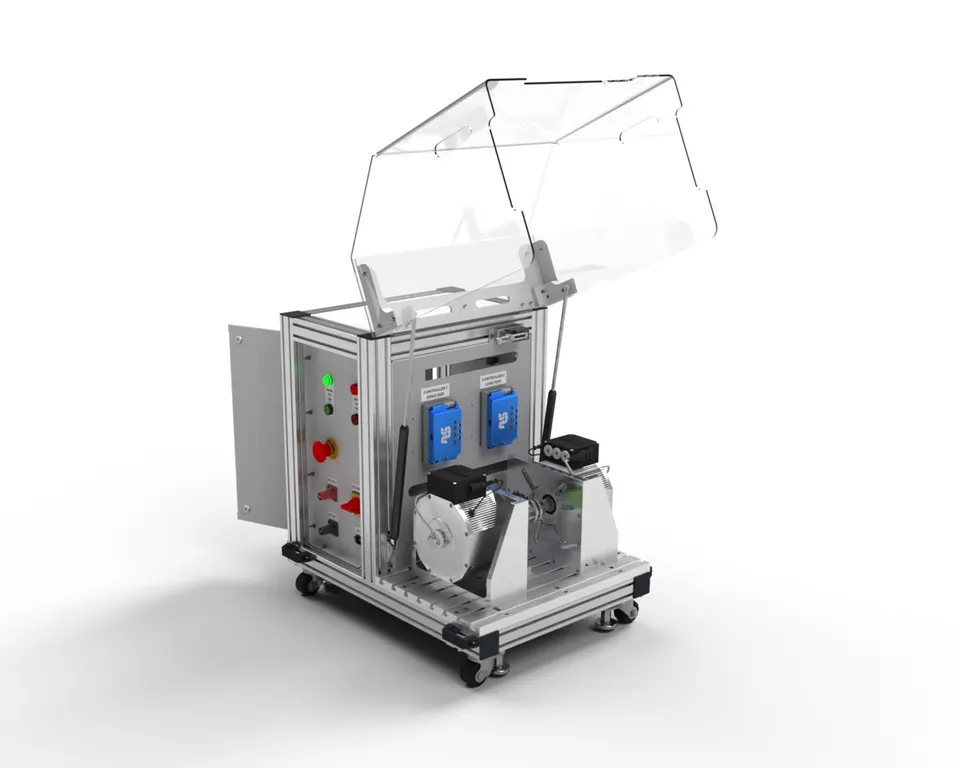
A motor test bench couples the motor under test to a controllable load, then measures how the motor behaves while you change speed, torque, and temperature. The load is usually a second motor or a brake. Sensors record torque, speed, current, voltage, and temperature, and the software turns that into curves you can trust.
In short, a bench lets you run a motor through its real operating range in a repeatable way. If you want the basics first, see our overview of what an electric motor test bench includes.
Takeaway: a bench replaces guesswork with measured, repeatable numbers.
The 7 Criteria to Choose a Motor Test Bench
Here is the short version before we go deep. Each criterion maps to one question you should be able to answer before you buy.
| # | Criterion | Key question |
|---|---|---|
| 1 | Power, torque, speed | Does it cover my largest motor, with headroom? |
| 2 | Dyno type | Do I need to back-drive and regen, or just load? |
| 3 | Sensors | Is torque accuracy good at my smallest torque? |
| 4 | Safety | Does it fail safe, with a hard e-stop? |
| 5 | Software | Can it automate and log an overnight run? |
| 6 | Portability | Situational, lowest priority: do several teams share it? |
| 7 | Cost and fit | Total cost, and can it be customized to my motors? |
1. Power, Torque and Speed Range
Start here, because it sizes everything else. Write down the peak and continuous torque, the maximum speed in RPM, and the bus voltage and current of every motor you plan to test, today and over the next two years. A bench that fits only your smallest motor will block your roadmap. One that is far oversized wastes budget and loses resolution at low torque.
For example, a 2 kW PMSM that peaks at 6 Nm and 4000 RPM needs a frame rated above both, so an 8 Nm, 5000 RPM bench leaves useful room. Check the continuous rating, not only the peak, because endurance tests run for hours at a steady point.
As a rule, size the bench to your largest planned motor, with around 20% headroom on torque and speed.
2. Dyno Type: Active, Passive or Hysteresis
The dynamometer, or dyno, is the load. Its type sets which tests you can run.
| Dyno type | How it loads | Can it drive the motor | Best for |
|---|---|---|---|
| Active (motor) | A second motor absorbs and can also drive | Yes, four-quadrant | Full mapping, regen, EV and robotics |
| Passive (brake) | Friction or eddy-current brake, absorbs only | No | Steady load points, endurance |
| Hysteresis / powder | Magnetic braking, smooth and controllable | No | Low-speed torque, fine control |
An active dyno is the most flexible, because it can both load and back-drive the motor. You need that for regeneration and full four-quadrant tests. A brake is cheaper and works well for fixed load points. For the full trade-off, see active dyno in test benches.
3. Measurement and Sensors
Your results are only as good as your sensors. The core set is a torque sensor, a speed and position sensor, and temperature probes, plus accurate current and voltage sensing from the drive.
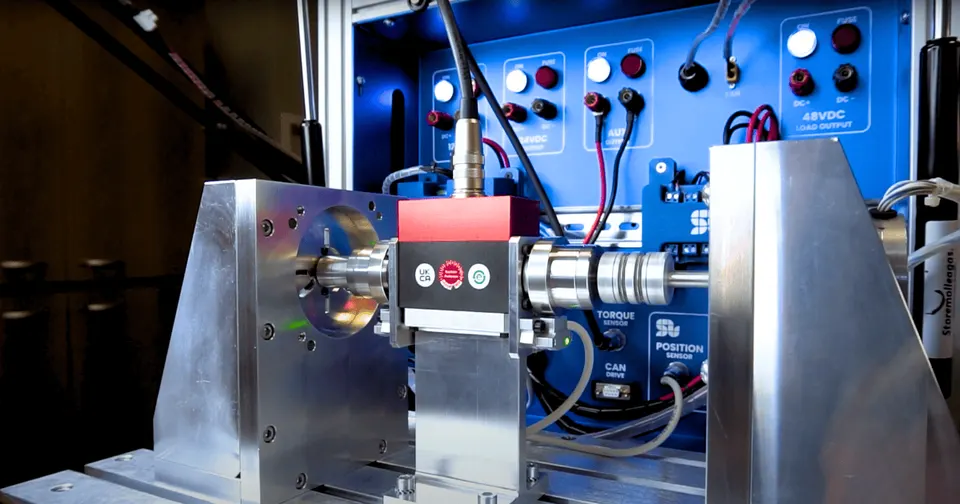
Check the torque sensor range and accuracy against your smallest torque, not just your largest. A sensor rated for 50 Nm will measure a 0.5 Nm point poorly. More on this in our guide to the torquemeter in test benches.
4. Safety and Emergency Systems
A spinning motor stores real energy, so safety is not optional. Look for a hard emergency stop, guarding around the couplings, over-speed and over-temperature cutoffs, and a controlled way to dump regenerated energy.
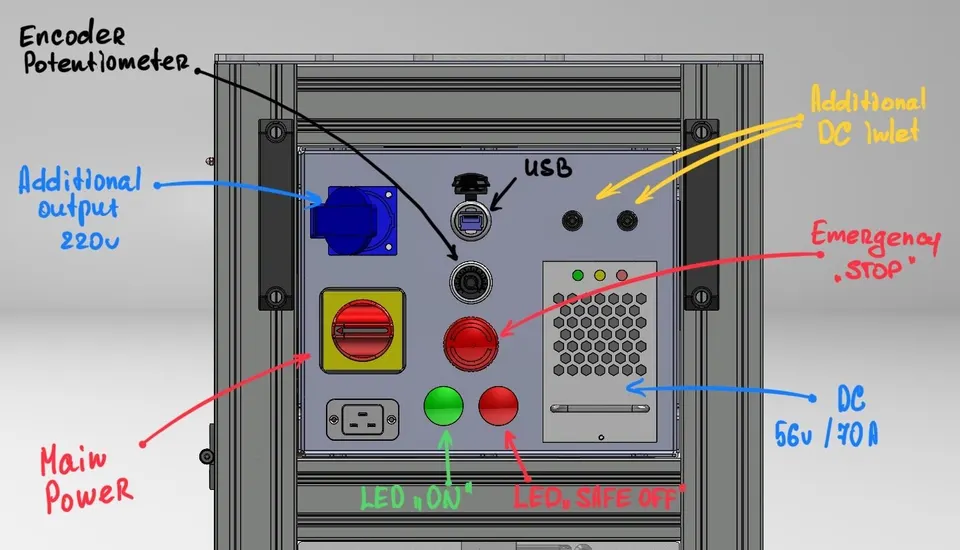
A good bench fails safe. If a sensor drops out or a limit is crossed, the system should stop the motor on its own. See how we approach this in emergency systems on a motor test bench.
5. Control, Software and Protocols
This is where many benches disappoint. You want automated test sequences, live data logging, and export to CSV or your own tools. Check the control interface too. Support for CANopen or EtherCAT lets the bench fit into an industrial setup and script long runs without a person watching.
Look for a few things that separate a tool from a toy: a scripting interface or ready test profiles, configurable pass/fail limits, and time-stamped logs you can replay later. A bench that only shows a live dial, with no export, turns every test into manual work.
Ask one concrete question: can the software run an unattended endurance test overnight and log every channel? If not, you will pay for it later in engineer hours.
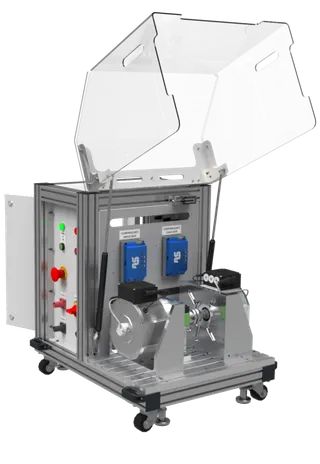
6. Portable vs Stationary
For most teams this matters least, so treat it as a tie-breaker, not a headline. A stationary bench is rigid, repeatable, and built for high power, and it suits a fixed lab. A portable bench only earns its keep if several teams share it or you demo on the road. Decide the first five criteria first, then let portability break a tie.
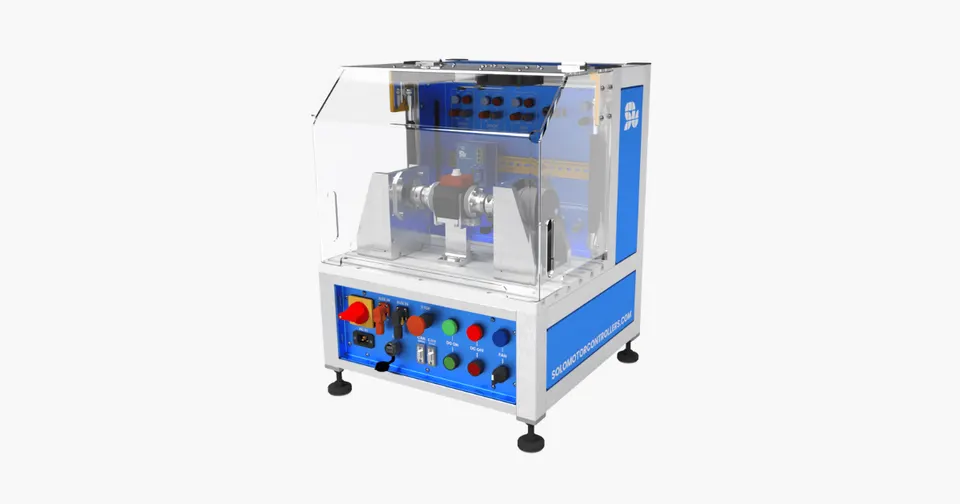
We compare both in portable vs stationary test benches.
7. Cost and Fit
Price is the last criterion, not the first, because the other six decide what you actually need. Think in total cost, not just the sticker. Add calibration, software, integration, and the cost of downtime if the bench is wrong. The bigger risk is not the price tag. It is buying a bench that almost fits, then working around its limits for years. Before you compare prices, make sure the bench can match your motors, not the other way around.
Takeaway: specify criteria 1 to 6, then let cost and fit tell you which bench to choose.
In-House, Standard, or Custom?
Most discussions frame this as build versus buy. In practice, building a full bench in-house is rarely realistic. A capable bench needs a rare mix of skills in one place: motor control, analysis algorithms, mechanics and integration, and the reporting software that turns raw logs into a usable report. Few teams have all of that to spare, and the ones that do usually prefer to spend it on their own product.
So the real decision is which bench to buy. A standard, off-the-shelf bench is fast and lower cost up front, but it fits a fixed envelope of power, voltage, and protocols. If your motor sits outside that envelope, a rigid bench becomes a limit you discover after the purchase. A customizable bench is built around your motors and your tests, so it adapts instead of forcing you to adapt. The trade-off is mostly about how standard your requirements are.
Pros, Cons & Trade-offs
| Path | Pros | Cons | Reality |
|---|---|---|---|
| In-house build | Full control | Needs motor-control, algorithm, mechanical, integration, and reporting skills together; long and high risk | Rarely worth it for most teams |
| Standard off-the-shelf | Fast, lower up-front cost | Fixed range, little customization; a risk if your motor or protocol is unusual | Fine only if your motors fit the standard envelope |
| Customizable (built to spec) | Fits your motors, voltages, and protocols at any level | Needs a partner who actually customizes | The safer choice when requirements vary |
No path is best for everyone. The common mistake is buying a standard bench that almost fits, then spending engineer time working around it. If your motors are unusual, or your roadmap keeps changing, a bench you can customize usually costs less over its life than a rigid one you outgrow.
How SOLO Builds Test Benches
At SOLO we build motor test benches around the same controllers we make, and we customize them to your needs at any level, from the dyno and sensors to the protocols and the report. That matters because a standard bench locks you into its envelope, while your motors and tests keep changing. We support DC, BLDC, PMSM, and AC induction motors on one bench, with active or brake loading, torque and temperature sensing, and automated logging over CANopen or EtherCAT. The aim is simple: you get a bench that fits your motors, not one you have to design around. You can see the current SOLO motor test bench and tell us your specs.
Conclusion
Choosing a bench comes down to seven decisions, taken in order: power range, dyno type, sensors, safety, software, portability, and cost and fit. Get the first one right and the rest follow, because the motors you test decide what the bench must do. Specify your peak motor, pick the dyno that matches the tests you need, and check that the software can log and automate the runs you care about. Above all, make sure the bench can be customized to your motors rather than forcing a standard fit. If you want a second opinion on a spec, the SOLO test bench page is a good next step, and our team can review your requirements.
FAQ
How much does a motor test bench cost?
It depends mostly on power and dyno type. A small brake-loaded bench costs far less than a high-power active dyno with full sensing and automation. Think in total cost, including calibration, software, and integration, not only the purchase price.
What is the difference between an active and a passive dyno?
An active dyno uses a second motor that can both absorb and drive the motor under test, so it supports four-quadrant and regeneration tests. A passive dyno uses a brake that can only absorb load. Active is more flexible, passive is simpler and cheaper.
Do I need a test bench or can I outsource motor testing?
Both work. A bench pays off when you test often, need repeatable data, or want to protect your intellectual property. Outsourcing fits occasional or one-off validation. The deciding factor is usually test frequency and how much you value owning the data.
Can one bench test BLDC, PMSM and induction motors?
Yes, if the controller and dyno support all of them. A bench built on a multi-mode controller can test DC, BLDC, PMSM, and AC induction motors without swapping the core hardware.
Tags:Buyer GuideMotor TestingTest Bench
Products in this article
Related articles
Efficiency Mapping a Motor: Method and What It Reveals
How to build a motor efficiency map on a test bench: the measurement method, the torque-speed grid, and what the map reveals about a motor.
In-House Motor Testing ROI: When a Test Bench Pays Off
When does an in-house motor test bench pay for itself versus outsourcing? A simple ROI and payback model for motor testing.
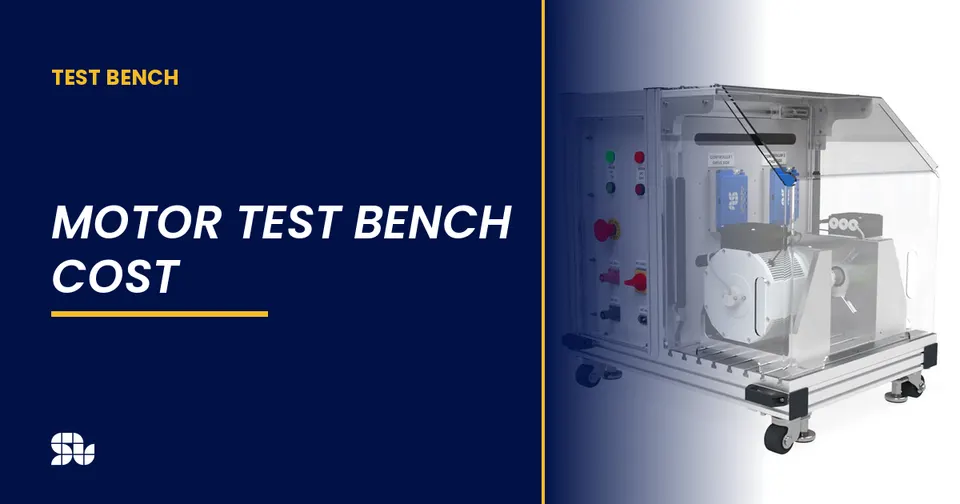
Motor Test Bench Cost: What Drives the Price
What a motor test bench costs and why: power range, dyno type, sensors, automation and safety. A transparent breakdown of what moves the price.
